
Getting more from grazing - Pasture for life visit to Balbirnie Home Farm Fife.
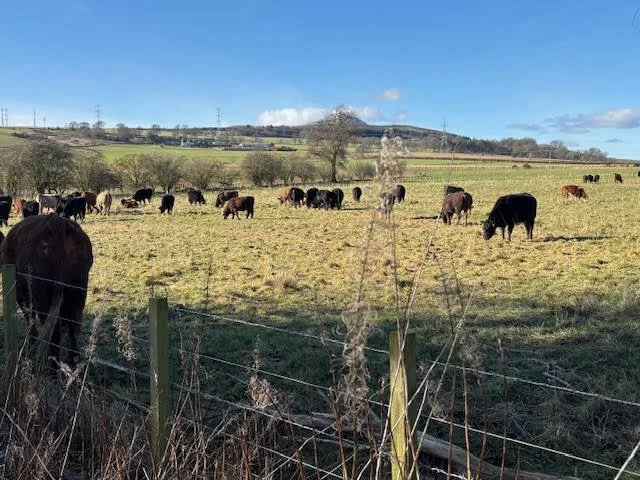
Johnnie Balfour and herd manager Laura hosted an informative and very thought provoking farm visit on a dry sunny but cold day at Balbirnie. The principles and practice of the “adaptive grazing” policy were explained followed by a farm walk showing the paddock grazing method which allows the suckler cows and followers to be permanently outside and never housed. Temporary electric fences are moved daily so that the cattle have a fresh strip of grass to graze every day. Conservation grazing provides winter grass so that no fodder is conserved as silage or hay. Cows are calved outside in April and calves are weaned at 9 months to allow the cows to recover before calving again. The “adaptive grazing” policy is similar in many respects to the grazing policy adopted by A G Street as described by him in Farmer’s Glory ( published 1932). In the 1920’s agricultural depression A G Street kept his dairy cows outside all year round and moved them on a regular basis. They were milked in the field using a mobile milking bail, which moved with them from field to field.
Johnnie pointed out the huge cost savings in not housing the cattle at all or conserving any winter fodder all with no artificial fertiliser applied. It was explained that the previous “conventional” policy had entailed housing the cattle for a 6 month winter with a lot of concentrate fed and all the associated machinery and labour costs of silage making, provision of straw, mechanical feeding, bedding, mucking out and dung spreading. Johnnie explained that the costs of the conventional system had exceeded sales and that it also had a considerable negative environmental impact.
The case made was strong and persuasive so why are we not all doing this? I would suggest that several factors need to be in place to enable a full “adaptive grazing” policy.
The land needs to be free draining and relatively dry. Low lying land which floods or becomes water logged in the winter would be unsuitable. Soils with a significant clay content would be more liable to poach with major damage to the sward and encouragement of weeds. A G Street was able to follow his grazing policy as his Wiltshire farm was on free draining chalk.
The land needs to be in a single block so that cattle can walk between each strip.
A knowledgeable and skilled herd manager who is enthusiastic for the system would be essential. Balbirnie is fortunate to have found this in Laura.
The right type of cow would be required. Johnnie explained that a moderate sized cow of 650 -700 kg with rumen capacity for an all grass diet rather than a cereal diet would be appropriate.
There will be many farms where an “adaptive grazing” policy would work, but I suspect more which for one reason or another would find it impossible to adopt every aspect. For these farms which would include Drumphin there are still aspects of the policy which are very relevant.
Making use of herbal leys to reduce artificial fertiliser usage.
Keeping cattle out for longer in the autumn by making better use of autumn stubbles and putting them out sooner in the spring to shorten the expensive winter housing period.
Calving outside to reduce calf disease issues.
Making the cow work harder by keeping the calf on the cow for 9 months instead of 6 to produce a stronger and more economically grown calf. Late weaning also causes much less stress and therefore risk of problems.
A moderate sized cow which maintains good condition on a grass diet.
With the introduction of “adaptive grazing” it was explained that the Balbirnie herd had changed from the larger continental type to a moderate size commercial cow. Native Aberdeen Angus bulls had been used together with some of the modern type of Angus bulls. Johnnie also pointed out that the calf of the moderate sized cow will mature and finish to produce the 350 kg carcase which is now the priority.
There does not seem to be a specific definition of Regenerative farming but the general thrust to a less intensive approach which is sympathetic to the land is well understood. The visit to Balbirnie Home farm as well as being a very enjoyable day, challenged our farming policy and forced a mental review which will help with the evolution of the farming policy at Drumphin. It did however reinforce the important role which quality Native Aberdeen Angus cattle have to play in Regenerative agriculture.